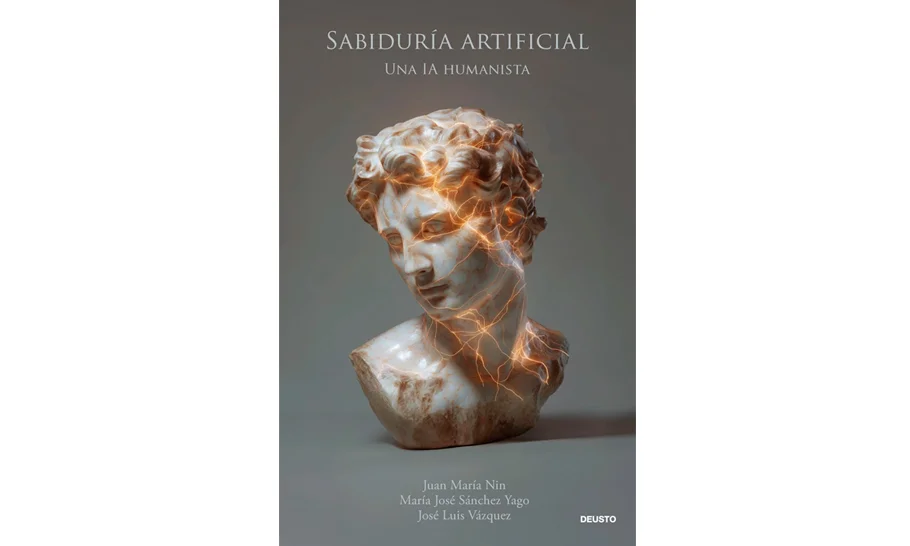
For centuries we have reserved a word, wisdom, for what neither knowledge nor computing power secures on its own, the ability to make good use of what we know. Sabiduría artificial (Artificial Wisdom), the book Juan María Nin, María José Sánchez Yago and José Luis Vázquez published with Deusto in 2026, dares to lend that word to machines. The subtitle already states the intent, a humanist AI, and the question it opens is exactly the one that interests me here, can wisdom be programmed, or is wisdom precisely what refuses to be programmed?
It is worth knowing who signs it, because the book is the child of its own make-up. Nin comes from the top of the financial world, he has sat in the offices where decisions affecting millions of people are taken. Sánchez Yago is a telecommunications engineer with training in philosophy, the humanities and neuropsychology. Vázquez, also an engineer, has led technology companies for more than two decades. The mix is not incidental, it is the putting into practice of a conviction I defend here, at Sapere Aude, over and over, that separating the technical culture from the humanistic one impoverishes us, and that the problems that truly matter are only understood when the two ways of looking work together. A banker, an engineer who reads philosophy and a technology executive writing together about artificial intelligence are, in themselves, a small demonstration of the thesis.
The book is organised in three movements. First, an «Entendimiento IA» (Understanding AI) that explains without jargon how these systems work and what they really do, because you cannot seriously argue about what you do not understand. Then comes the heart of the essay, «Una IA humanista» (A Humanist AI), where the authors hold that an intelligence that is merely efficient is not yet fully intelligent, and that a truly advanced AI would end up taking on certain universal values, truth, justice, freedom, the care of life. Finally, «IA, economía y empresa» (AI, Economy and Enterprise), the ground where all this lands, with the unsettling idea of the «posthuman enterprise» as the horizon we are already moving towards without having paused much to think about it.
The idea that made me think the most is also the most debatable, and the two things usually go together. The authors start from a distinction I share entirely, the one that separates being efficient from being intelligent. A machine that optimises a metric without asking whether the metric is worth it is powerful and blind at once, as was that instrumental reason I wrote about when reviewing «When We Cease to Understand the World». So far, agreed. Where the book takes a leap that is hard to follow is when it suggests that a sufficiently advanced AI would embrace those values almost of its own accord, as if wisdom were the natural destiny of intelligence pushed to its limit. This is where the humanist in me pumps the brakes. The story Labatut told points to the very opposite, that one can master without understanding, that technical brilliance and moral disaster can coexist without contradiction in a single mind. Intelligence does not lead to virtue on its own. If it did, there would be no need to educate anyone.
Here lies, it seems to me, the tension that runs through the whole book. Sabiduría artificial aspires to a machine that decides well for us. The project I defend here aspires to exactly the opposite, people who never stop deciding. Kant’s «sapere aude», dare to think for yourself, was a call not to hand over to another the work of judging, and it makes no difference whether that other is an authority, a dogma or a language model. It was about this risk of delegating thought that I wrote in «The Courage to Think». Delegating the calculation is sensible and freeing. Delegating the judgement is another matter. The authors’ merit is that they are aware of this, which is why they insist that artificial wisdom should not be a substitute for the human kind but, at best, a mirror that forces us to spell out which values we want the system to reflect. Every model we release into the world, they write, carries our legacy in some way.
For anyone who runs an organisation, the most useful part is the third, and not for its forecasts about the posthuman enterprise, always risky, but for the question beating within it. When a tool hands you an answer before you have finished framing the question, the temptation to spare yourself the thinking is enormous. The difference between the manager who uses AI to think better and the one who uses it to avoid thinking is the same that, when reviewing «Total Competition», set the strategist apart from the one who merely executes. No dashboard, no model, spares us the responsibility of deciding which problems are worth dedicating ourselves to. Wisdom, if the word still means anything, begins right here, in the prior question no machine will put to us unless we teach it to.
Not everything convinces me. The tone is decidedly optimistic, and the authors lean more towards steering the technology than towards setting limits on it, a legitimate bet but one that pushes into the background those cases where what is needed is not a wiser AI but, simply, no AI at all. The coexistence of three such different voices brings richness and, at the same time, some unevenness, and the reader notices when the engineer is writing and when the one who comes from the humanities is. The very metaphor of the title, so suggestive, carries an ambiguity the book never quite resolves, whether «artificial wisdom» means a wise machine or, more modestly, a wiser way of using machines. I suspect the second sense is the right one, and it is what makes the book worthwhile.
Because in the end Sabiduría artificial turns out to be, perhaps without fully meaning to, a book about us more than about machines. The values we ask of AI, truth, justice, care, are the same ones we have struggled to embody for centuries. Wanting to programme them into a system forces us into the uncomfortable work of making them explicit, of saying out loud what we hold to be just, what caring is, which truth we want. Perhaps that is the unexpected gift of this technology, that to teach a machine wisdom we will first have to remember what ours consisted of.
This is the kind of reading I share here, in «Readings», books that help you think and decide better. If you want to bring this way of thinking to your work or your organisation, I can help you put it into practice with talks, training and workshops.