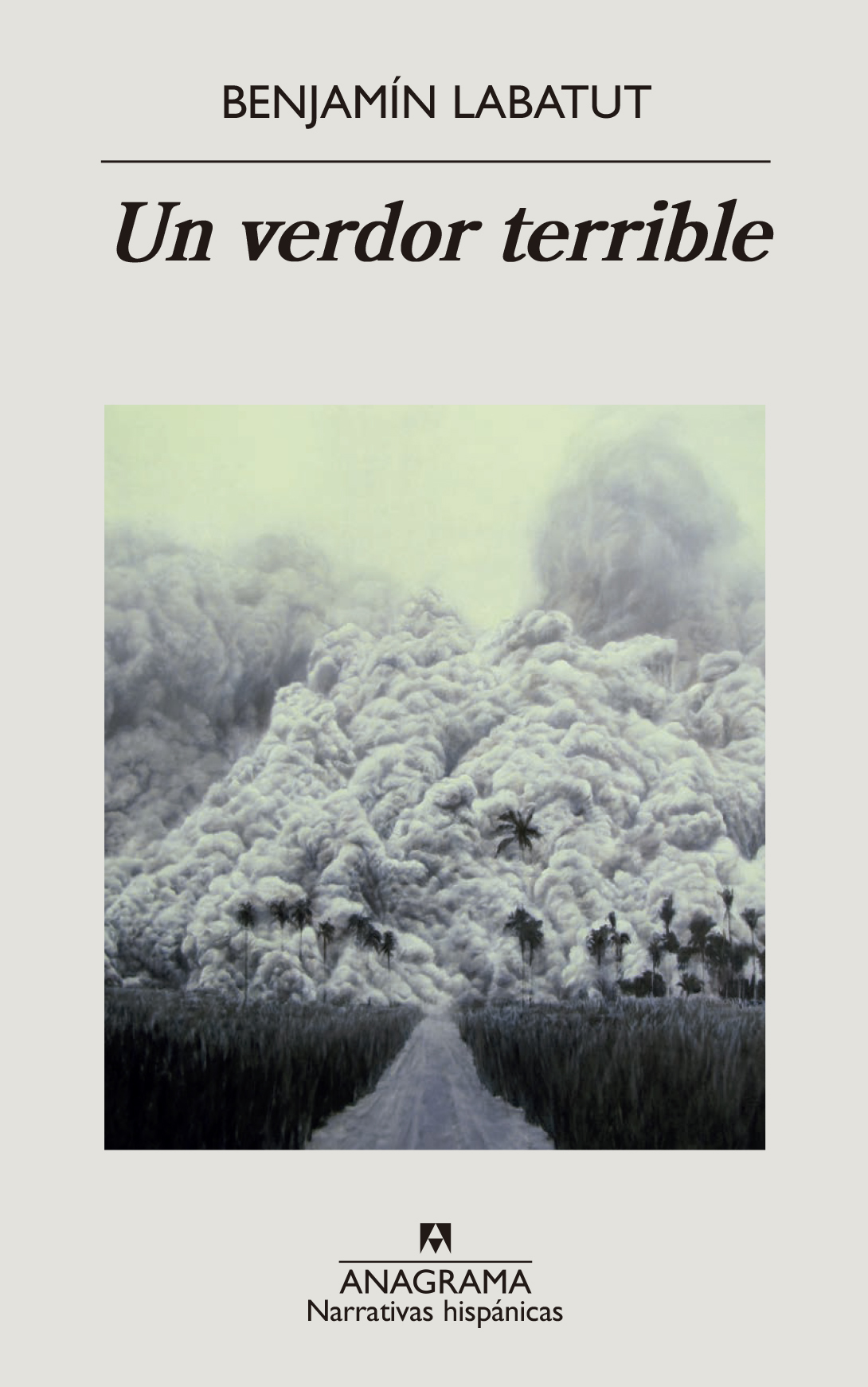
Fritz Haber learned to draw nitrogen from the air and, with that gesture, fed half the planet. The same man personally directed the chlorine attacks in the trenches of the First World War, and from his line of research would come, years later, the compound the Nazis would use in the gas chambers, where part of his own family died. With this figure at once saving and monstrous, Benjamín Labatut opens When We Cease to Understand the World, and it is very hard to put the book back on the bedside table.
Labatut, a Chilean born in Rotterdam in 1980, published this book with Anagrama in 2020. The English translation was a finalist for the International Booker in 2021 and ended up on Barack Obama’s summer reading list, which turned a strange literary object into an unexpected phenomenon. The strangeness comes from the genre. They are five pieces that run through pivotal discoveries of twentieth-century science and the minds that conceived them, but they are neither popular science nor biography. Labatut starts from real facts and keeps adding fiction in a dose that grows as you advance, to the point that by the end you no longer know for certain where history ends and his imagination begins. The first chapter is almost documentary. The last is almost a dream.
In between pass Karl Schwarzschild, who solved Einstein’s equations from the Russian front and guessed the existence of something that terrified him, a singularity where space and time broke down, what we now call a black hole. Alexander Grothendieck passes through, perhaps the most profound mathematician of the century, who one day abandoned mathematics, shut himself in silence and ended up convinced that there was an evil at the root of reality. And through the longest chapter passes the birth of quantum mechanics, with Werner Heisenberg feverish on an island in the North Sea and Erwin Schrödinger shut away in a sanatorium, both feeling their way towards a new physics that worked perfectly and that, at the same time, no one could fully understand.
This is where the book’s title reveals its ambition. When We Cease to Understand the World is not, at bottom, about science. It is about the moment when human knowledge reaches so far that it can no longer be understood. We can predict a particle’s behaviour with absolute precision and, at the same time, be unable to say what it is or where it is until we look at it. We master without understanding. This is the idea that gives the book its name, and it is far more than a physicists’ curiosity.
Because this experience, that of using extremely powerful tools we do not fully understand, has stopped being exclusive to laboratories. It is exactly our everyday relationship with the artificial intelligence systems we already use to decide, hire, diagnose or write. They work, often better than us at specific tasks, and not even their creators can fully explain why they give the answer they give. Labatut does not talk about AI, but his book is one of the best descriptions I know of the vertigo we ought to feel, and often do not, when we delegate judgement to a black box. It was precisely about this risk of delegating thought that I wrote in «The Courage to Think». Kant’s «sapere aude», dare to know, was not an invitation to accumulate answers, but to not hand over to another the work of thinking. When We Cease to Understand the World shows the face Kant did not see, what happens when that daring takes us to a place where there is no longer anything solid beneath.
There is a second lesson, harder, that speaks directly to anyone who leads people or projects. Haber’s story is the story of instrumental reason taken to its extreme, a brilliant, effective intelligence, able to solve any technical problem put in front of it, and completely orphaned of judgement about which problems are worth dedicating oneself to. Haber is supremely competent and a moral disaster, and the two things do not contradict each other, they coexist in the same person. Anyone who has managed a team will recognise the temptation to confuse the two, to reward the ability to execute and forget the prior question of what is being executed and why. Technical brilliance is no guarantee of good judgement. Sometimes it is its alibi. The book is, in this sense, an antidote against the intoxication of pure competence, the same that makes whole organisations run very fast towards places where no one has stopped to ask whether it is worth arriving.
From here comes the third thread, that of hubris. Labatut’s characters share an obsession that makes them able to see what no one had seen and that, at the same time, devours them. It is the old theme of Icarus, the fall that comes right after the highest flight. Schwarzschild guesses the black hole and dies a few months later. Grothendieck touches the bottom of abstraction and loses himself there. The lesson is not that one should not think deeply, quite the opposite. It is that deep thought demands a kind of hygiene, a knowing when to stop and look back, that these geniuses lacked and that we, immersed in performance cultures without brakes, do not have in surplus either. Examining before deciding is not slowness, it is the condition for not ending up prisoners of our own intelligence.
It is worth pausing too on how it is written, because there is a lesson of method. Labatut is a humanist writing about physics and mathematics, and the book is a practical demonstration that separating the two cultures, the arts and the sciences, is an impoverishment. He explains quantum mechanics better than many textbooks not because he simplifies, but because he ties it back to life, the fear, the ambition and the madness of those who thought it up. For anyone who educates, or who wants to educate themselves later in life, here is a model, knowledge is not truly understood until it is reconnected with the human experience it came from.
It is worth reading knowing what kind of book it is. The border between what really happened and what Labatut adds is deliberately blurred, and the author does not mark where the documentation ends and the invention begins. It is a chosen stylistic trait, not an oversight, and it grows as the book advances, up to the final chapters, where fiction gains weight. Whoever wants to sort the historical fact from the recreation will have to check it on their own.
The title comes from an image in the last chapter, that of the trees which, when they are sick and about to die, produce one last excessive blossoming, a terrible, excessive greenery that looks like life and is, in fact, the warning of the end. It is a metaphor hard to get out of your head. Perhaps this race of ours to know and control everything, to accelerate everything, has something of that greenery. The question Labatut leaves is not whether we should stop understanding the world, it is whether we will know how to recognise the moment when our own brilliance has become a symptom.
This is the kind of reading I share every month here, in «Readings», books that help you think and decide better. And if you want to bring this way of thinking to your work or your organisation, I can help you put it into practice with talks, training and workshops.