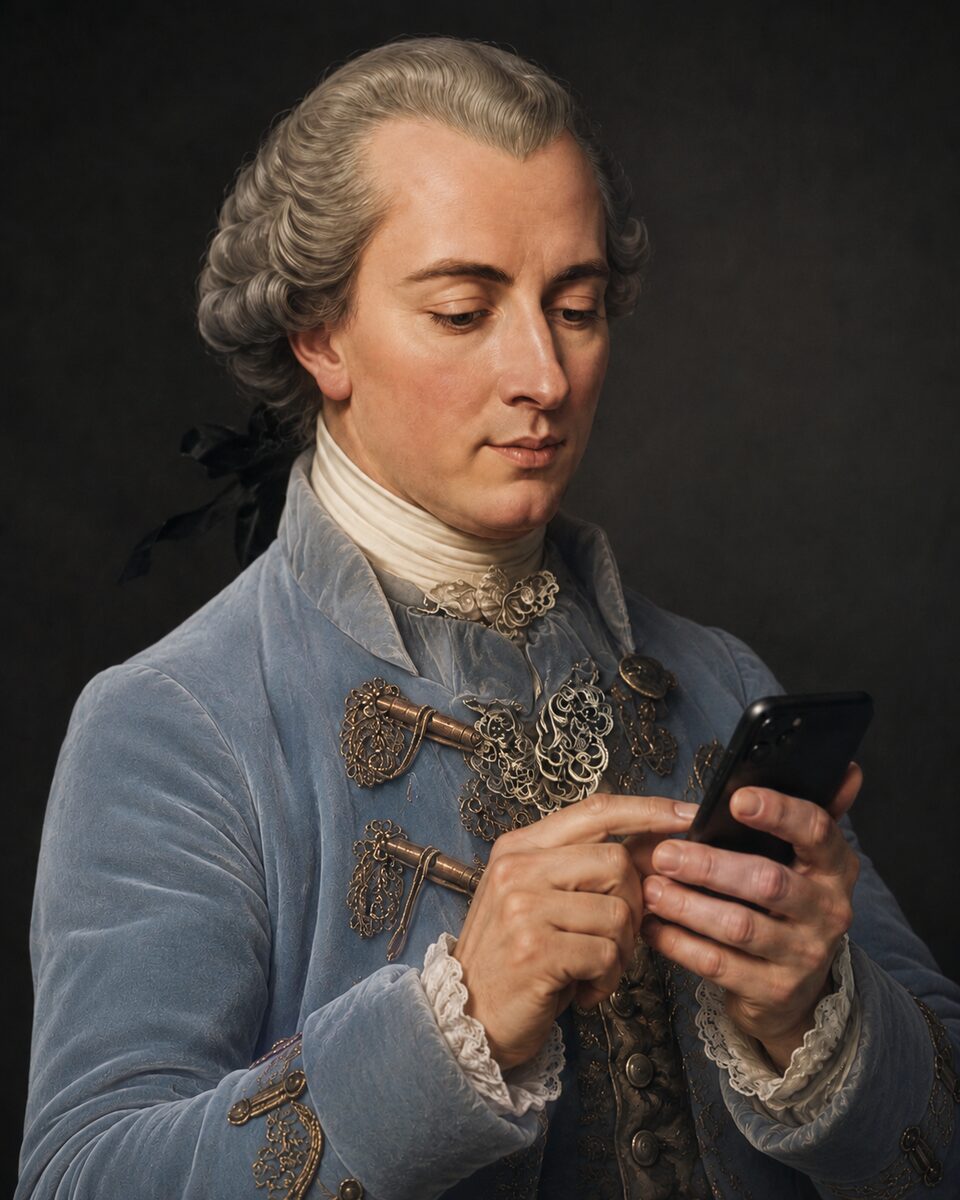
In 1784, answering the question “What is Enlightenment?”, Kant gave a definition that still stings. Enlightenment is the human being’s emergence from a state of immaturity, and he added an uncomfortable qualification: an immaturity for which we ourselves are to blame. The motto he attached to it is the one that gives this project its name. Sapere aude. “Dare to know”, or, more precisely, “dare to use your own understanding”.
The key term is “immaturity”, and it is worth understanding properly, because it does not mean what it appears to. Kant is not talking about a lack of intelligence. Immaturity is the inability to use one’s own understanding without the guidance of another, and it is culpable when the cause is not a lack of capacity but a lack of resolve and courage to use it. At bottom it is a matter of comfort. It is very comfortable to be immature, Kant writes. If I have a book that thinks for me, a spiritual director who has a conscience for me and a doctor who decides my diet for me, I need make no effort at all.
Replace Kant’s book, director and doctor with the feed, the influencer and the recommendation algorithm, and the sentence reads as though it were written today. The immaturity of the twenty-first century is not forced upon us by anyone. We choose it every time we delegate to a system the work of forming an opinion, because thinking is tiring and the system already hands us the conclusion, packaged, and confirming what we already believed.
Kant added a distinction that is often forgotten and that qualifies everything he says. He defended the public use of reason, daring to set out one’s own judgement before others as a thinking member of a community, and he considered it the engine of progress. He did not, however, call for permanent insubordination in every sphere. A worker can carry out their duties while arguing openly to change them. The distinction is a fruitful one: obeying a rule does not exempt you from thinking it through, nor from saying aloud why you believe it ought to be otherwise.
Here we should avoid a naive reading of Kant. Daring to think for yourself does not mean distrusting every expert and reinventing the wheel each morning. Kant was no enemy of accumulated knowledge, and no one can verify everything on their own. The distinction is finer than that. It is one thing to use other people’s knowledge as raw material, and quite another to delegate the final decision to it. You can read ten analyses before deciding. What cannot happen is that the analysis makes the decision for you.
In business, this difference separates the manager who uses consultants, data and benchmarks in order to think better from the one who uses them in order not to have to think. The first keeps responsibility for judgement. The second subcontracts it, and is then surprised that no one in the organisation dares to say what they see. A leader’s autonomy of judgement sets the ceiling for the autonomy of the whole team.
In private life, the courage to think carries a social cost that Kant knew well. Whoever thinks differently is a nuisance, and the easy path is to fall in with the group’s opinion so as not to pay the toll of friction. But an opinion you have never examined is not yours. You have merely inherited it.
This week’s exercise. Choose one of your own opinions that you take for granted, about your work, about a public issue, or about yourself. On a sheet of paper, write it down and then answer by hand: where does it come from, exactly? Did you reason your way to it, or did you absorb it from someone else? What concrete piece of evidence would make you abandon it? If you cannot find any, perhaps it is not a conclusion but a slogan.
Sapere aude.