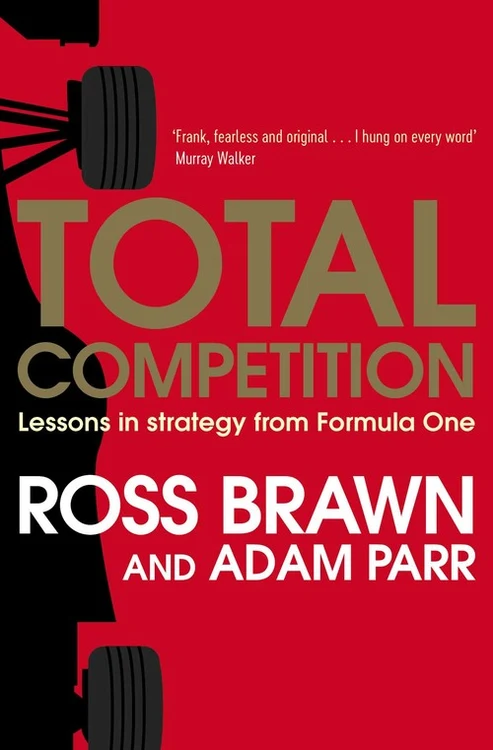
In Formula 1 everything is measured. Thousands of sensors, millions of data points per lap, simulations that predict a tyre’s degradation to within tenths. And yet, when Ross Brawn explains how he won championships, he barely talks about technology. He talks about how he thought. Total Competition, the long conversation he holds with Adam Parr, is a book about strategy disguised as a book about racing, and it is one of the best defences I have read of an idea that seems obvious and is not, that the decisive advantage, even in the most technology-driven environment you can imagine, is still a way of thinking.
It is worth knowing who is speaking. Ross Brawn led the technical and strategic side of four teams and amassed twelve world titles, with Benetton, with the Ferrari of the Schumacher era, with his own Brawn GP that won the championship in 2009 in the most improbable way, and with Mercedes. Adam Parr had been chief executive of Williams and, before this book, had already written a graphic novel titled, precisely, The Art of War. The two build the book as a dialogue, Parr asks and Brawn answers, and the whole is read through the treatise on strategy that Sun Tzu wrote twenty-five centuries ago. This idea alone is what I defend here, at Sapere Aude, again and again. A classic that seems utterly remote turns out to be the sharpest tool for understanding how a high-performance organisation is run. This is applied humanism in management, not as a slogan, but in action.
The first lesson Brawn draws from Sun Tzu is the one that gives this review its title. The good strategist wins before competing. Not because they cheat, but because by the time the moment of decision arrives they have already done the work of thinking. They have understood the terrain, foreseen the scenarios, they know their own strengths and the rival’s better than the rival does. The race, on Brawn’s pit wall, was often decided on Friday, not Sunday. This discipline of examining before acting is exactly the opposite of the brilliant improvisation we so admire, and it connects fully with what I explained in «Examine Before Deciding». The quality of a decision does not show in the spectacular moment when it is made, but in all the quiet thinking that preceded it.
Brawn has an example of his own that illustrates it better than any theory. In 2009, his team, freshly born from the ashes of Honda, arrived at the first race with a car that was, quite simply, faster than the others. Not by magic, but because they had read the new aerodynamic regulations with more attention and more imagination than anyone, and had found a legal interpretation, the famous double-decker diffuser, that the rest of the grid had overlooked. By the time the rivals reacted and copied the idea, Brawn GP had already built up an advantage that ended up delivering both titles, the drivers’ with Jenson Button and the constructors’, in its single season of existence. That championship was won in large part months before the first start, in the way a technical document was read. It is Sun Tzu in its purest form. Victory is prepared long before the battle.
And here comes the core of the book, what makes it interesting far beyond motorsport fans. Brawn’s strategy is not an algorithm. In the sport that generates the most data in the world, the decisions that made the difference, when to pit, when to take a risk, when to protect a driver and when to sacrifice one, were not made by a model. They were made by human judgement, formed over decades, able to read what the data does not yet say. Brawn uses all the information in the world, and at the same time never delegates the final decision to the information. This distinction, which seems small, is the whole game. It is the same one that separates the manager who uses consultants and dashboards to think better from the one who uses them so as not to have to think. At a moment when the temptation is to delegate judgement to a system because the system already gives us an answer, a book that shows the opposite from the heart of technology is more timely than it seems.
What is surprising about Brawn, and what dismantles the cliché of the cold genius, is that his leadership lessons are almost all human. He insists on humility, on investing in people and in the team’s culture, on simplifying the complex without making it simplistic. In an environment where it would be easy to treat people as one more resource alongside the wind tunnels, Brawn argues the opposite. A team wins when people think, and they think when someone has built an environment where it is worth doing so. The leader’s job is not to have all the answers, it is to create the conditions for judgement to circulate rather than pile up in a single office. Anyone who has read what I write about attention will also recognise Brawn’s insistence on simplifying. In a deluge of data, the scarce capability is not gathering information, it is sorting out what matters and keeping your eyes on it.
The book has a third layer that is often overlooked. Under the title Total Competition there is not a defence of winning at any cost, but a reflection on how to compete within a framework of rules and why that framework matters. Brawn and Parr devote a good many pages to the governance problems of Formula 1 itself, to the excessive power of certain figures and to the inherited privileges that distort competition. Total competition is not the war of all against all. It is the one that brings out the best in everyone precisely because there are rules that everyone respects, and that someone must make sure are fair.
Not everything works equally well. The conversation format, which gives freshness and makes Brawn’s voice sound authentic, also makes the book at times resemble a very long interview, with repetitions and digressions. The parallels with Sun Tzu, which illuminate very often, at some point feel a little forced, as if the structure demanded an ancient quotation that the content did not need. And anyone with no interest in Formula 1 will have to cross very technical passages about specific races to reach the general idea. It is worth crossing them, but it helps to know they are there.
In the end, what you take away is not any circuit anecdote, but a way of understanding the craft of deciding. Brawn shows that strategy is not guessing the future nor having the best machine, but thinking so well and so deeply before the decisive moment that, when it arrives, there is almost nothing left to decide, because the work is already done. The question it leaves is uncomfortable for anyone who runs anything. How many of our decisions do we win before the start, and how many do we race in desperation because we did not want to spend the time thinking them through?
This is the kind of reading I share every month here, in «Readings», books that help you think and decide better. And if you want to bring this way of thinking to your work or your organisation, I can help you put it into practice with talks, training and workshops.