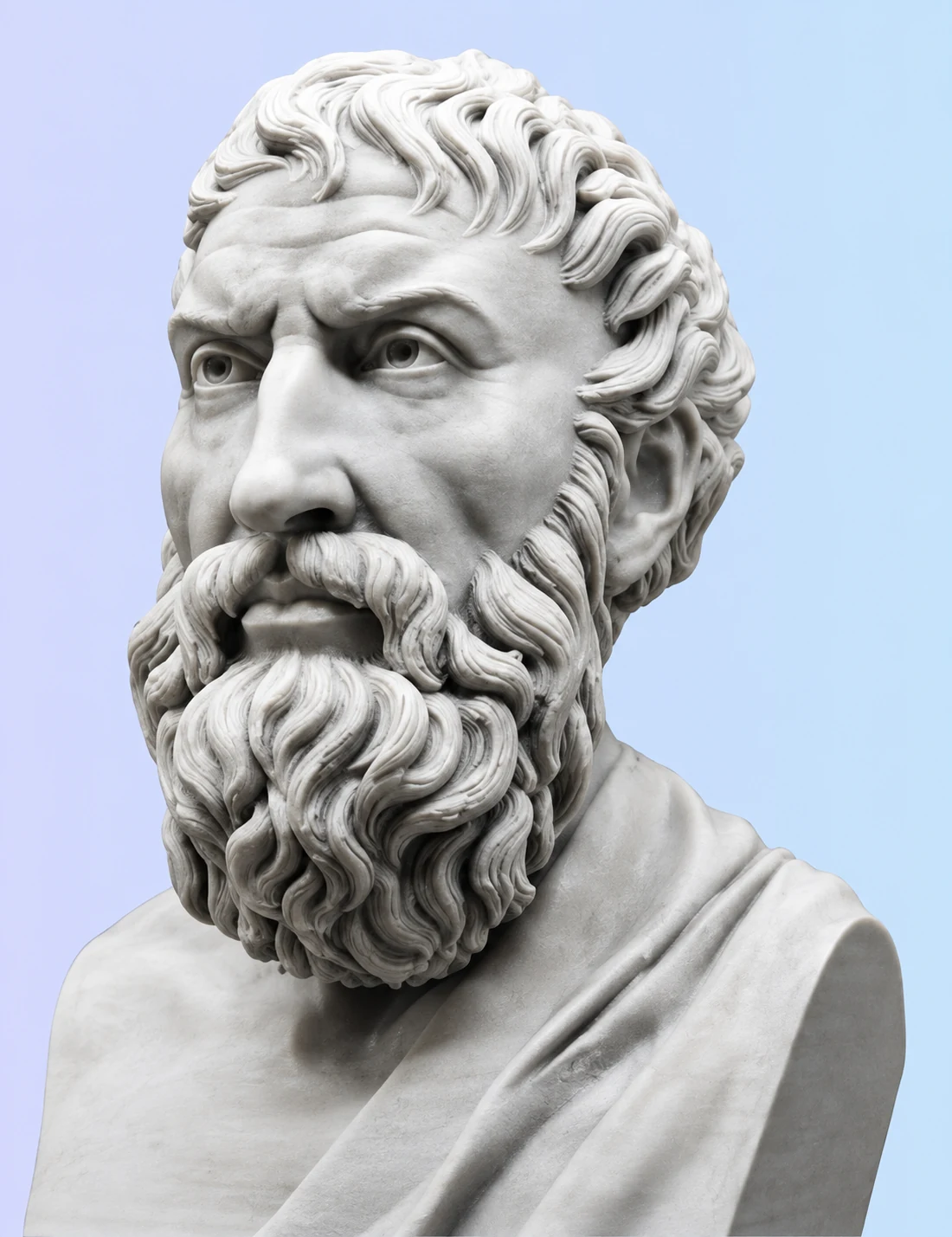
The most famous manual of Stoicism was written neither by an emperor nor by a rich man, but by a former slave. Epictetus was a slave in the Roman empire, and when he was at last able to teach philosophy he opened his manual, the Enchiridion, with the following sentence: “Of the things that exist, some depend on us and others do not”. The whole of the practical wisdom of Stoicism can be found in those words.
It is worth clearing up a misunderstanding before going on, because “stoic” in everyday language has come to mean someone who bears pain without complaint. That is not it. Stoicism does not ask us to suppress our emotions or to resign ourselves. It asks for something more intelligent, to distinguish precisely what is under your control and what is not, and to concentrate all your energy on the first without wasting any on the second. What depends on us, said Epictetus, are our judgements, our decisions and our actions. What does not depend on us is practically everything else, including the final result of what we do.
Applied to uncertainty, this distinction is far more useful than any motivational technique. When a project depends on factors you do not control (the market, a third party’s decision, luck, and so on), the Stoic does not ask “will it turn out well?”, because that is not in his power. He asks “have I done everything that depended on me?”. The first question breeds anxiety without producing anything. The second breeds action and, as a side effect, calm.
The Stoics did not merely distinguish, they also trained. One of their practices was the premeditation of adversity, calmly imagining, before it happens, what we fear, so as to strip it of its power to surprise us. This is not pessimism, it is preparation. Someone who has mentally rehearsed a setback meets it with a cooler head and decides better, whereas someone who lives expecting everything to go well is left paralysed the day it does not. In managing teams, this trained serenity is what separates leading from reacting. A boss I had many years ago used to say: “to manage is to anticipate”.
That said, it would be dishonest to present the dichotomy as though it were always so clean and clear. In real life, many things depend on us only in part. The effort depends on me, but the effort bears on the result, which does not depend on me entirely. Some later Stoics refined this by speaking of three categories rather than two, to make room for what we have influence over but not control. There is a perverse use of the idea that is worth denouncing, invoking “accept what you cannot change” to justify making someone endure an unjust situation that could in fact be changed. Stoicism is about agency, not about submission.
With that caution in mind, the practice remains powerful. Much of what torments us is energy spent on what we do not control, what others will think, what has already happened, what might yet happen. Every minute invested here is a minute stolen from the only ground where your action counts, which is the present and what is indeed in your hands.
This week’s exercise. Take a worry that is going round your head right now and, on a sheet of paper, draw two columns. On the left, write everything about that situation that genuinely depends on you. On the right, everything that does not. Once you have it, forget the right-hand column and do one single thing, today, from the left-hand one. Clarity does not come from solving everything, but from knowing where you can act.
Marcus Aurelius, who was the most powerful man in the world in his time and a follower of Stoicism, wrote at night reminding himself of these things, because even an emperor controls far less than it seems. Of all that worries you this week, how much of it is really yours, and how much energy are you spending on the rest?
Sapere aude.