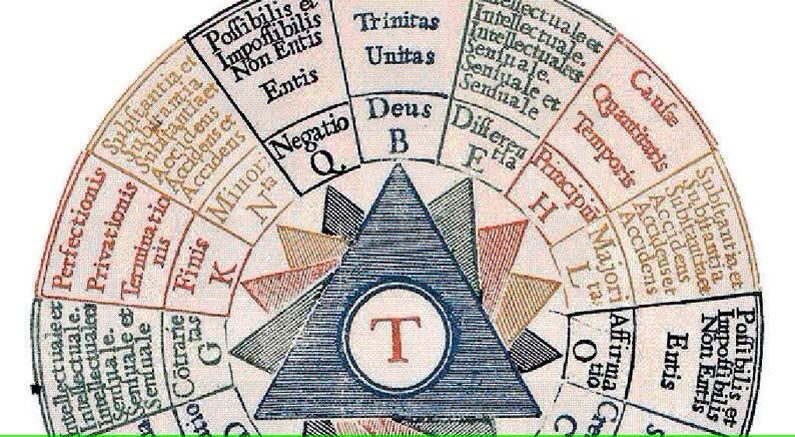
In the 13th century, a Majorcan designed a thinking machine made of concentric paper circles. Ramon Llull wrote on it letters that stood for concepts —goodness, greatness, truth— and, by turning the circles, generated every possible combination of them. He called it the Ars, and he devoted his life to it. He wanted something outlandish: to prove the truths of faith by a mechanical procedure that any reasonable person, of whatever religion, would have to accept.
It is worth clarifying what that artefact really was, because it has become a curious museum piece and little more. The Ars did not divine anything. It was a combinatorial system, a set of basic concepts and rules to combine them systematically, so that no relevant combination was left unexplored. Centuries later, Leibniz read Llull and dreamed the same thing, an alphabet of human thought and a calculus that would settle any dispute by saying “let us calculate”. Modern logic and, ultimately, computing, have one of their roots here.
The parallel with today’s artificial intelligence is too neat to let pass. A language model does, on a scale Llull could not have imagined, exactly what the wheel did: recombine pieces according to rules to produce new combinations. And here the lesson appears, which is not the one it seems.
Llull believed that the mechanical combination of concepts led to truth. In this he was wrong, and his mistake is precisely the one we should avoid today. Recombining is not understanding. A machine that generates every possible sentence on a subject understands none of them, just as Llull’s wheel believed in nothing it printed. Combination generates candidates. The judgement to sort which are worth keeping does not come from the wheel. Someone has to supply it.
There is a detail of the wheel that makes it even more current. Llull conceived it to work the same for anyone, regardless of who turned it. This apparent neutrality is seductive, because it seems to take human bias out of the equation. But a machine that combines according to rules someone has chosen is not neutral, it carries the decisions of whoever designed it. With artificial intelligence exactly the same happens, and its appearance of objectivity is precisely what makes us lower our guard.
In business, this has an immediate application and two sides. The useful side is that, since much of innovation is combinatorial —joining two ideas no one had joined— it is worth forcing these combinations rather than waiting for inspiration. The other side is that when a tool gives you a hundred combinations in a second, the bottleneck is no longer generating them, it is having the judgement to choose one. Without that judgement, the machine only makes you go faster towards the wrong decision.
In learning something similar happens. Learning is not accumulating isolated concepts, but being able to combine them, to see what Stoicism has to do with running a team, or Llull’s Ars with a chip. Whoever only memorises has the pieces, but not the wheel.
This week’s exercise. Choose two concepts that have nothing to do with each other, one from your work and one from outside it (say, “budget” and “gardening”). On a sheet of paper, write them down and force yourself to find three real connections between them, however strange they seem. You are not after the good connection on the first try. You are after exercising the muscle of combining, which is what no machine can save you from.
Llull’s wheel has not disappeared. We have finally built it, and it turns faster than ever. The question he did not ask, and that now falls to us, is who supplies the judgement when the machine already combines everything. Are you doing it, or have you delegated it without realising?
Sapere aude.