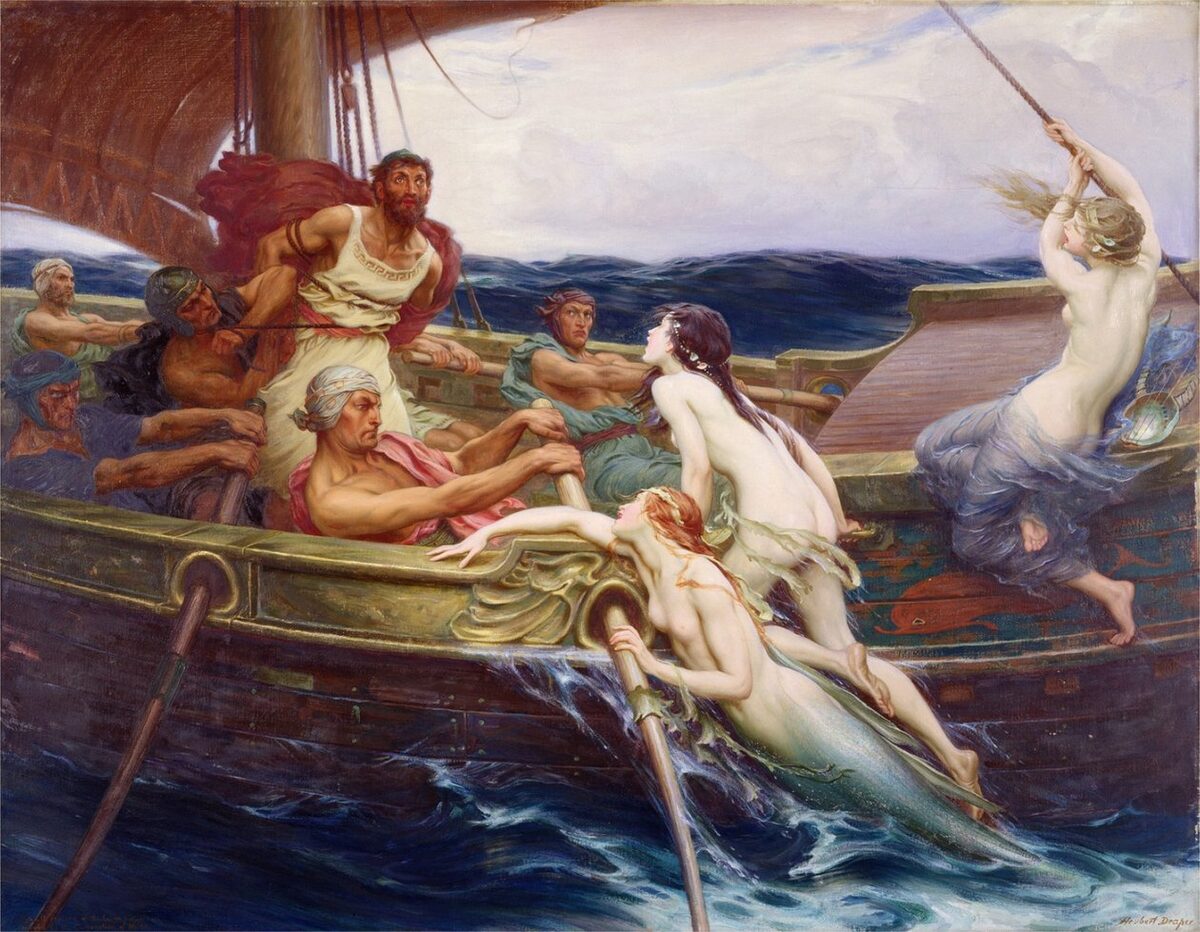
Before reaching the islands of the Sirens, Ulysses already knows what awaits him. The sorceress Circe has warned him. The song of those creatures is so tempting that no sailor can resist it, and whoever hears it turns the ship towards the reefs and is dashed to pieces. The obvious solution would be to plug your ears and sail past. But Ulysses wants something harder. He wants to hear the song and survive. To manage it he does something that seems contradictory: he renounces his own freedom in advance.
The order he gives the crew is precise. They are to plug their ears with wax so they hear nothing. Him, though, they are to tie tightly to the ship’s mast. And, this is the decisive point, if he begs them to set him free, they are not to obey, but to tie him even tighter. When the moment comes, Ulysses hears the song, goes mad, orders and implores them to untie him. The crew, however, deaf and faithful to the earlier order, tighten the knots. The ship passes. Ulysses has heard what no one had heard without dying, and lives to tell it. It is in the Odyssey, Book XII.
It is easy to read this as praise of willpower, but it is exactly the opposite. Ulysses does not trust his will. He knows for certain it will fail him. His “lucid self”, the one on deck before the danger, knows that his later self, the one subjected to the song in his ear, will be another man, incapable of deciding well. That is why the “lucid self” makes a decision about the “weak self”: it strips it, in advance, of the ability to choose. Philosophers call this a “commitment device”. Jon Elster titled a whole book on rationality with this image: “Ulysses and the Sirens”. In it he discussed the strategy by which a person or institution voluntarily restricts its future options to avoid making irrational decisions or falling into a future temptation.
Let us reflect on this idea. We tend to think that being free means always keeping every door open, never closing off any option. Ulysses teaches the opposite. Sometimes the freest decision is to remove one of your own future options, precisely because you know that, when the moment comes, you would make a bad choice. Deciding today, in the cool, can be a rule that protects you from yourself tomorrow, in the heat.
In business, the mast and the wax take a thousand forms. A pricing policy that forbids you to go below a certain threshold exists precisely so you do not have to decide it in front of the customer pressing you. A closed budget, a public deadline, a hiring criterion fixed before meeting the charming but wrong candidate, and so on, are knots that your “sensible self” or, as we said before, your “lucid self”, ties so that your self of the moment cannot untie them. The team’s job, often, is to be the deaf crew: to remind you of the rule you yourself set when you could see clearly.
In personal life the mechanism is the same and, many times, you already put it into practice. Not keeping at home what you know you will eat if it is within reach is more effective than resisting it every night. The automatic transfer to the savings account on payday saves for you before you can give it up. The alarm clock at the other end of the room, and so on. These are not discipline tricks. They are decisions made in the cool so they do not depend on your will in the heat.
In learning, the crew’s wax is as important as the rope. Often you do not need to fight distraction in the moment. It is enough to remove its source in advance: silence the notifications, leave the phone in another room, block out the study hour in your diary as if it were an unmissable meeting. Do not trust that you will resist the Sirens’ songs. Better not to hear them, or to be already tied when you do.
We should not idealise the mast. Tying yourself down also has a danger. Circumstances change, and the knot that protected you yesterday may be a trap today. There are decisions that demand just the opposite, staying flexible and able to change course. Wisdom is not tying yourself to everything, but knowing how to tell the difference. Tie yourself where you know your “future self” will predictably be weaker than you. Leave your hands free where what will be needed is to adapt. Confusing the two, tying yourself to the wrong mast and tightening the knots as the ship goes down, is the opposite error, and no less costly.
This week’s exercise. Think of a recurring decision in which your “calm self” and your “agitated self” do not agree. The one you always break when the moment comes. Write on a sheet of paper the rule your “calm self” wants kept, in a single line. Below it, design the mast and the wax: not the good intention, but the concrete mechanism that will make the rule keep itself, without depending on your will in the heat. Who will be the deaf crew? What source could you remove outright? A rule without a mechanism is only a wish.
What is the Siren you already know will sing to you this week, and what mast can you prepare today, while you can still see clearly?
Sapere aude.