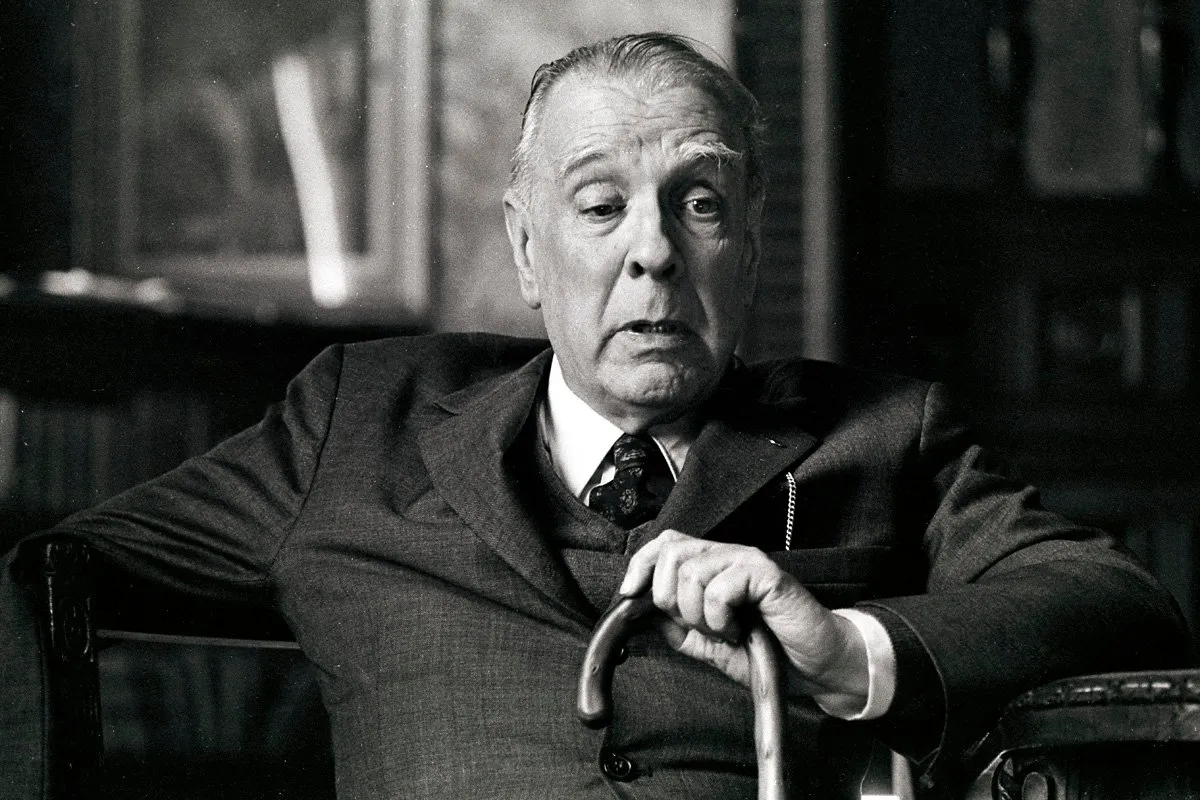
In 1942, Jorge Luis Borges published a short story about a young man from Fray Bentos, in Uruguay, called Ireneo Funes. After a fall from his horse, Funes is left paralyzed and discovers that he remembers everything. It is not an excellent memory. It is an absolute one. He recalls every leaf on every tree on every mountain, and every time he has seen them. He can reconstruct an entire day, but doing so takes him another entire day.
What looks like a gift turns out to be a curse. It troubles Funes that the dog seen in profile at 3:14 should have the same name as the dog seen from the front at 3:15. To him they are two different things. He even devises a numbering system in which every number has its own name, with no rule connecting one to another. Borges closes the reflection with a line that has become famous: “To think is to forget differences, to generalize, to abstract. In the crowded world of Funes there was nothing but details, almost immediate ones.”
Borges’s intuition has a real basis. The Russian neuropsychologist Aleksandr Luria studied for decades a man, Solomon Shereshevsky, whose memory was practically unlimited. He could repeat endless lists years after hearing them. He also had serious difficulty understanding metaphors, grasping the general sense of a text, or recognizing a face when its expression changed. Remembering everything made it hard for him to understand.
The paradox is that our ability to understand the world depends on our ability to forget most of it. When we say “dog,” “client,” or “crisis,” we discard thousands of details to keep what they have in common. Without that renunciation there would be no concepts, and without concepts there would be no thought.
In a way, we live in Funes’s world. Organizations accumulate more data than ever, dashboards display dozens of indicators updated in real time, and artificial intelligence lets us store and retrieve everything. The temptation is to believe that more information means more understanding. Borges warns us of the opposite. Without the ability to separate the essential from the incidental, data does not make us wiser. It leaves us like Funes, lying in the dark, overwhelmed by details he cannot put in order. As Borges puts it: “To think is to forget differences, to generalize, to abstract.”
In business, the Funes syndrome has clear symptoms: fifty-page reports that nobody reads, meetings that review thirty indicators and decide nothing, managers who always ask for one more figure before making a decision. The good manager is not always the one who knows everything, but the one who knows what can be ignored at any given moment. Often, a leader’s most valuable work is to simplify: to say which three things really matter.
In our personal lives, forgetting is also a form of wisdom. Some people hold on to every grievance, every detail of every argument, and cannot move on. Selective memory is not always a flaw. Often it is what allows us to see the broader pattern of a relationship or a period of life, above the individual incidents.
When it comes to learning, the lesson is straightforward. Studying is not memorizing everything, but understanding a subject well enough to know what is structural and what is anecdotal. The student who highlights the whole book has not learned how to highlight. Learning is, in large part, learning what to discard.
We should not idealize forgetting. Some things must not be forgotten, and the memory of an organization or a country is essential if it is not to repeat its mistakes. Abstraction has its dangers too, because generalizing too quickly is the road to stereotypes and hasty conclusions. The question is not how little to remember, but which details to let go of and which to preserve. That is precisely the choice we should not hand over entirely to any machine.
This week’s exercise. Take the latest report, long email, or set of data that you have had to review at work. Without looking at it again, write down on a sheet of paper the three ideas you remember as important. Then compare them with the document. Did you retain the essentials or the details? If you had to sum it up in a single sentence, what would it be? This exercise in distillation is, quite literally, thinking.
Of all the information you have received this week, what is the one thing worth remembering a year from now?
Sapere aude.