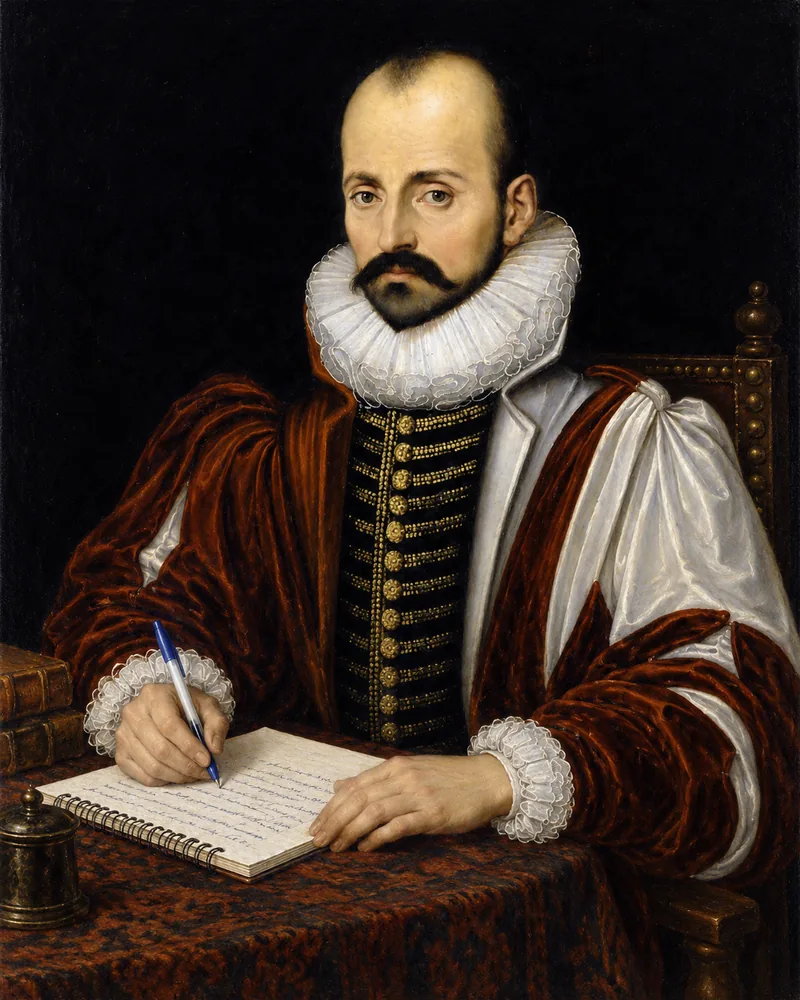
In 1571, a thirty-eight-year-old French nobleman shut himself in the tower of his castle, surrounded by books, to do something no one had done in quite this way before, write about himself to find out what he thought. Michel de Montaigne did not want to prove any thesis. He set about writing to see what would come out, and the genre he invented he named with a calculated modesty. Essais. Attempts, tries, essays-at.
The word matters, because today “essay” sounds to us like an academic paper with a bibliography, and it was just the opposite. A Montaigne essai is an attempt to think something out loud, with permission to be wrong, to contradict oneself and to change one’s mind halfway down the page. His motto sums it all up. Que sais-je? What do I know? It is not a sceptical surrender nor an “everything is relative”. It is a question of method, the one he places before any certainty to force it to justify itself.
Montaigne’s discovery, and the reason it is worth reviving him, is that writing does not serve to jot down what you already think. It serves to discover it. When you try to put an idea into writing, in an orderly and connected way, you see at once where it springs a leak, where you have been fooling yourself with a formula that sounded good. Paper is merciless in a way that conversation and thinking inside your head are not.
Montaigne did another thing that is hard for us today. He allowed himself to change his mind within the same text and leave the trace of it. He did not correct yesterday’s self to pretend he had always been right, but showed thought in movement. In a culture that penalises changing your mind as if it were a weakness, this honesty is almost subversive. Whoever has never contradicted themselves in public has probably stopped thinking in public, or has never really done it.
This clashes head-on with the present age. Everything pushes us towards the instant opinion, the three-line comment written before we have finished thinking. It is faster and gives more immediate satisfaction. The problem is that this speed has an invisible price, many people do not know what they really think about the things they most claim to defend, because they have never stopped to write it out in full. They have positions, but not arguments.
In business, this idea has a very concrete translation. Forcing yourself to write a decision on a page, in prose and not in the bullet points of a slide, is one of the cheapest and least used thinking tools there is. The bullets of a PowerPoint let you hide the holes in the argument behind loose words. Connected prose does not. If you cannot explain it in a paragraph that holds together, you have not yet thought it through, however much it may look like you have.
For anyone who wants to learn for real, the lesson is direct. You have not understood something until you can write it in your own words without looking at the source. Until then you only recognise it, which is an illusion of understanding very easy to mistake for understanding itself.
This week’s exercise. Choose something you believe you understand well, from your work or from a subject that worries you, and write a page on it by hand, without looking at anything and without stopping to correct. The aim is not for it to come out well. It is to locate the exact point where your explanation breaks, where you realise that what you took for granted you did not have so clear after all. That point is, precisely, where real learning begins.
Montaigne spent twenty years asking himself the same question without ever exhausting it. Of all the things you would now defend with confidence, how many have you actually written out from top to bottom, and how many have you only repeated?
Sapere aude.