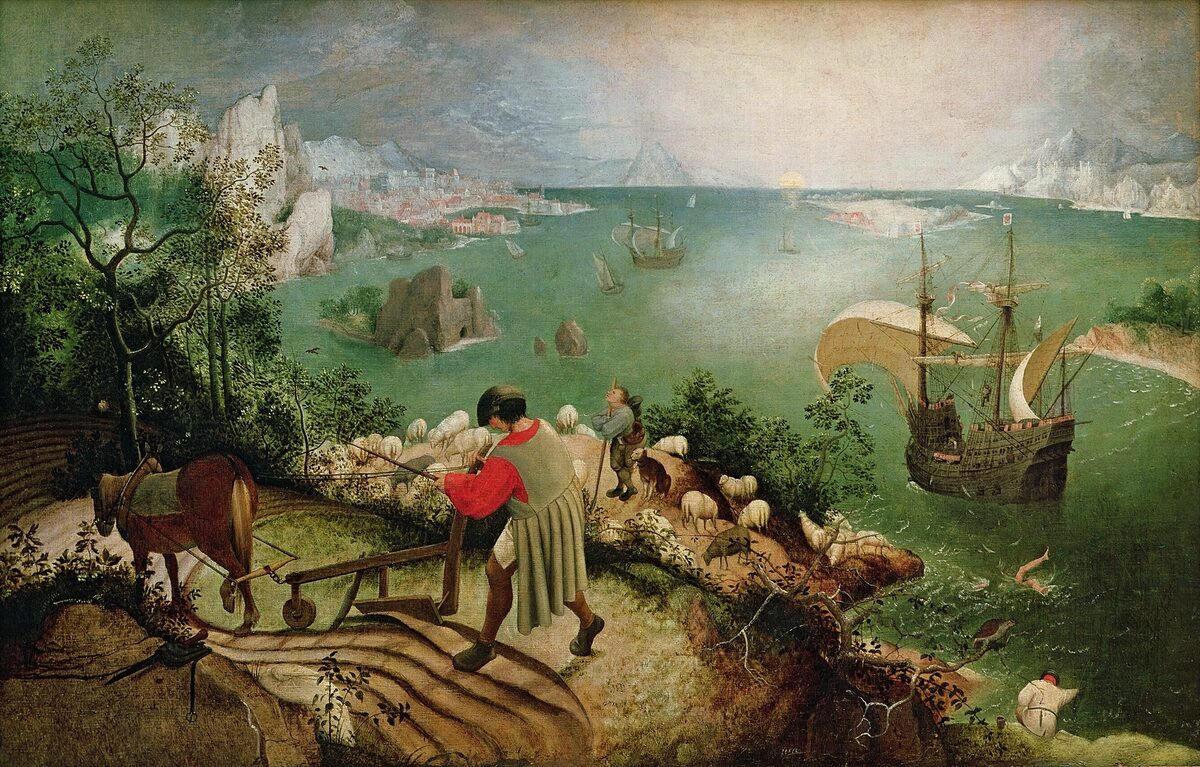
In a painting in the Brussels museum, the most important thing happens in a corner where no one is looking. A ploughman turns the soil, a shepherd looks up — the wrong way — a fisherman watches his line, and an expensive, elegant ship sails calmly on. And down there, at the very right, two white legs disappearing into the green water: it is Icarus, who has just fallen from the sky, and the whole world is busy with something else. The painting is called Landscape with the Fall of Icarus and is attributed to Pieter Bruegel the Elder. Let us be precise: since a 1996 technical examination it has been doubted that the hand is his —perhaps it is an early copy— but the composition is his beyond dispute. And the composition is all that matters here.
In December 1938, a young Auden visited that museum and came out with a poem, “Musée des Beaux Arts”. His thesis about the old masters is that they understood well the place suffering occupies: it happens while someone else is eating, opening a window or walking dully along. Everything turns its back, unhurried, on disaster. And the expensive ship, he writes, “sailed calmly on”.
It is worth pinning down what it is not, because the easy reading is a moral one: what an indifferent world, in which we are alone only when we suffer. It is true, and it is there. But I want to pull another thread, less consoling and more useful. In Ovid’s account, the ploughman, the shepherd and the fisherman do lift their heads: they see the two men flying and are left astonished, convinced they are gods. Bruegel makes them not look. The change is not about compassion, it is about attention. The catastrophe is there, in plain sight, and it exists for no one because no one is looking at it.
Because attention is not a passive window that lets the world in. It is a decision —almost always unconscious— about what goes in the foreground and what stays out of the frame. We do not see everything and then choose; we only see what we have decided to look at. Whatever stays outside the frame, however important, is as if it had never happened. Bruegel’s Icarus does not lack drama. He lacks a spectator.
This has never been as literal as it is now, when a whole industry designs where your attention ends up. The feed is the ploughman: it keeps you busy with the furrow in front of you so you do not lift your head. Choosing what to look at has stopped being automatic and has become the first act of thinking. Before deciding well, you have to see well; and to see well, you have to decide where you look.
In business, every team has its dashboard, and every dashboard is a frame: it puts four figures in the foreground and pushes the rest to the edge. Revenue, conversion, the quarter’s target: the ploughman turning his furrow. Meanwhile, some weak signal falls into the corner —the customer who has stopped complaining because they have already left, the best person on the team who has gone quiet, the small recurring defect no one notes down. It is not hidden. It is unattended. The useful question in a meeting is not “how are the numbers?”, but “which Icarus is falling in a corner while we all watch the plough?”.
In personal life, the same, and it is harder. Your attention is finite and someone profits from spending it for you. The important-but-not-urgent —health, a relationship you let cool, a decision you keep putting off— rarely shouts. It sinks into the water without a splash while you scroll the furrow in front of you. It does not disappear because it stops mattering. It disappears because you stop looking at it.
In learning there is an expression among museum educators: slow looking. The premise is that you do not see what you have not learned to look for. A trained eye finds in the same painting a dozen things the distracted eye misses: not because they were not there, but because looking is a skill, not a reflex. Learning, in the end, is widening what you are able to notice. Whoever only accumulates data has more furrows; whoever learns to look has more frame.
We should not idealise it. You cannot attend to everything: selective attention is not a flaw, it is a condition. The ploughman who stopped to look at every falling Icarus would never plough. The skill is not to see everything, but to choose well what you put in the foreground and, now and then, force yourself to look at the edges. Sorting the relevant signal from the noise in the corner is, once again, an act of judgement.
This week’s exercise. Take ten minutes and a screen with the painting (search for “Bruegel, The Fall of Icarus”). Look at it doing nothing else: no phone, no music. First find everything that is not Icarus: the plough, the sheep, the ship, the city in the background. Then, on a sheet of paper, answer two questions by hand: in the decision or situation you have open right now, what is the plough you keep watching? And what is the Icarus falling in a corner that you have decided, without deciding it, not to look at? The slowness is not a drawback of the exercise. It is the exercise.
A ship sailed calmly on while a boy fell from the sky. What is sailing calmly on, in plain sight, that you have not yet dared to look at?
Sapere aude.